★★★★★ | Five stars
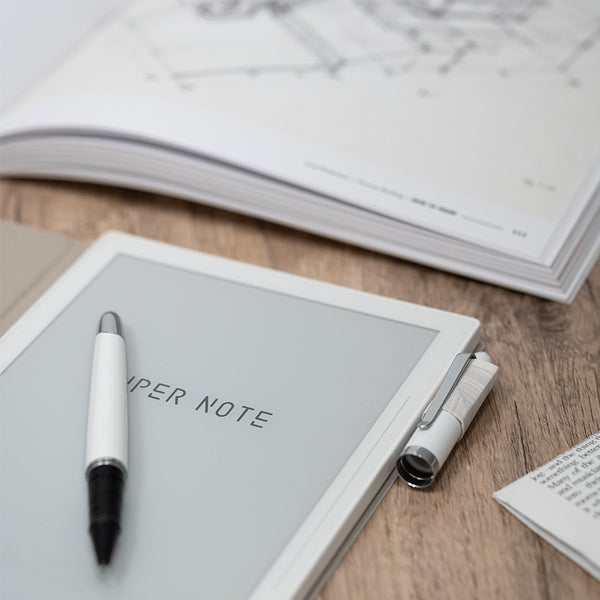
The Supernote A5 X is a splendidly stubborn gadget. It belongs to a category that has spent years trying to convince the world that a computer can be useful without becoming a television, games console or miniature office. Where most tablets invite you to install another application, the Supernote offers a more old-fashioned proposition: put a pen in your hand and get on with the work. That emphasis makes it feel less like a compromised iPad than a notebook that has quietly developed some remarkable electronic abilities.
I have owned an A5 X, one of the earlier large-format Supernote tablets, and its place in the crowded e-paper world is worth revisiting. The device is not the newest machine in the company’s lineup. That is part of its interest. Digital notebooks have developed rapidly, yet the basic pleasure of an electronic page that can be written on, organized and revisited remains intact. The A5 X was built for exactly that purpose, and it belongs to an era when the category still felt like a strange, promising alternative to ordinary tablets.
The screen measures 10.3 inches, a size that makes the device feel closer to a conventional notebook than to a phone. Supernote’s original documentation specifies a monochrome E Ink panel at 226 pixels per inch, 32GB of storage, 2GB of memory and a 3,800mAh battery. None of these figures would win a modern tablet comparison. They should not have to. The A5 X is not supposed to decode demanding video or maintain a dozen animated windows. Its basic task is displaying a page and preserving what the pen puts on it.
The important difference between a notebook and a phone is not simply that the former has fewer functions. It is that a notebook seems to ask less of its owner. Open a browser and you are immediately presented with an entire world of possible obligations. Open a page and the next decision is your own. The Supernote has an interface built around notebooks, documents and a manageable set of tools. Even the architecture of its software reflects the idea that the user’s attention belongs to the work, not to the device.
A notebook with an opinion about writing
There are many ways to make a digital pen impressive. Manufacturers can talk about pressure sensitivity, stroke delay, processors and resolution until the pleasure of handwriting becomes buried under numbers. Supernote’s more interesting accomplishment is conceptual. It treats writing as the main event. A page is not an accessory to a larger operating system; it is the operating system’s reason for existing. That orientation changes how the machine is approached. You are not shopping for an app to solve a problem. You are looking for the right page.
The A5 X was designed around a distinctive pen experience, with Supernote offering ceramic-nib writing instruments that emphasize durability. A conventional pencil wears down as it crosses paper, and many digital pen tips need occasional replacement. A durable writing tip is a small but welcome departure from that routine. Of course, no manufacturer can promise that every user’s preferred pen feel will be identical. Some people want friction, others smoothness. The pleasure is in having an instrument designed to encourage writing rather than merely simulate touchscreen gestures.
The software deserves as much attention as the physical tablet. Supernote’s note-taking system developed a reputation for organization, linking and navigation features that go beyond simply collecting hundreds of pages in folders. A good notebook interface must solve an awkward problem: handwritten pages are wonderfully flexible while you are making them, but can become difficult to find when months of work accumulate. Digital features are valuable when they address precisely that difficulty. They should make a note easier to recover without making it harder to write in the first place.
One reason the e-paper category appeals to writers is that the roughness of early thinking is preserved. A polished word processor invites the mind to behave as though it is already writing a finished document. Handwriting allows false starts, arrows, cramped additions and words crossed out so firmly that the page starts to look like evidence from a police investigation. Those marks are not defects. They are often the visible process of figuring something out. The A5 X gives that process a place in a searchable, movable electronic archive.
That combination is particularly attractive for someone juggling different projects. One notebook can hold the outline for a story, another the sequence of an interview, and a third the collection of errands that would otherwise infest the margins of both. The ability to move from one to another is useful precisely because it resembles the familiar practice of keeping separate paper notebooks, without the equally familiar experience of leaving the right one at home. Organization becomes a quiet convenience rather than a complicated productivity doctrine.
The case for keeping an older e-paper tablet
The A5 X’s age is no reason to dismiss it, although it is a reason to be precise about the software and support available today. Its original system and specifications belong to a previous generation of digital paper. Newer Supernote models offer different designs and capabilities, and a buyer should check what support, accessories and replacement options remain available for the older device. This is not the kind of purchase to make solely because an old review once called it wonderful. It is equipment that should suit a present-day workflow.
The absence of color is another distinction worth considering. A modern color e-paper tablet can make diagrams and highlights more expressive. But black-and-white notes retain their own elegance. They are straightforward, legible and free from the temptation to turn the page into a design project. For work that consists mostly of words, grayscale can be entirely sufficient. A notebook needs to make writing clear before it needs to make writing beautiful. The A5 X understands that hierarchy.
Unlike an ordinary computer, an e-paper notebook can also make waiting feel less empty. The pause before an appointment, the quiet portion of a train journey or the interval between conversations becomes a chance to capture something. I have always liked the idea of carrying an object that encourages a thought to become visible. The greatest virtue of a portable writing tool is not that it turns every minute into productive labor. It is that a useful idea does not have to compete with a flood of notifications for the privilege of being recorded.
Supernote’s distinctiveness becomes clearer alongside the reMarkable family. The reMarkable 2 is exceptionally spare, the Paper Pro gives color and a larger writing surface to that minimalism, and the Move makes the same idea more portable. Supernote places greater emphasis on the notebook as an organized working system. Both approaches are defensible. The important thing is that each company has resisted the temptation to make a general-purpose tablet with a slower display. There is a refreshing amount of conviction in that refusal.
Price and value are more complicated than a list of features suggests. It is easy to calculate the number of inexpensive notebooks one could buy for the cost of an electronic one. It is harder to price the ability to keep years of scattered material together, recover an old note and carry an archive without carrying a shelf of paper. That does not mean every writer needs an A5 X. It means the value proposition is practical in ways that are often invisible to a casual shopper. The investment is in a habit as much as in hardware.
Five stars for the Supernote A5 X because it represents one of the most attractive ideas in personal computing: a machine that regards thought as more interesting than distraction. It has the limitations of its age, and a modern buyer should look carefully at newer alternatives. But its underlying philosophy remains sound. Give a writer a generous page, a pen and a way to keep what has been written. The result need not be spectacular. Sometimes it is enough for a gadget to make space for the next sentence.
Original model specifications: Supernote A5 X manual.

