★★★★★ | Five stars
The difficult part of keeping a notebook is rarely the writing. It is remembering to have the notebook with you at the moment a useful thought arrives. An idea has a habit of appearing on the subway, in a queue or halfway through a conversation, when a full-size writing tablet is inconveniently far away. The reMarkable Paper Pro Move answers that small but persistent problem by making the digital notebook genuinely portable. I spent time with the device in New York, including cafés and on the move, and its size changed the nature of the experience.
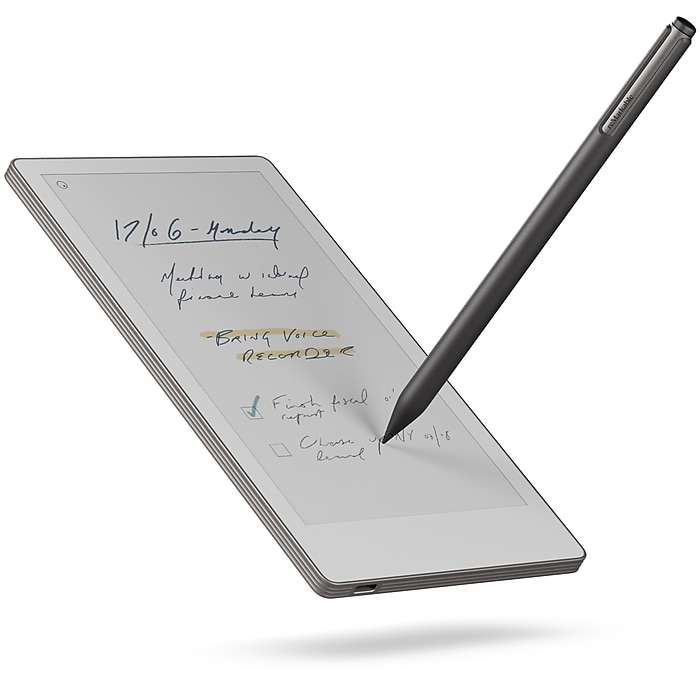
The Move has a 7.3-inch color Canvas display and weighs about 230 grams. Those figures matter because they put it in a different category from reMarkable’s larger devices. It is closer to the paper notepad that a reporter might keep at hand than to the slate that lives on a desk. The screen is tall and relatively narrow; an article or document meant for an expansive page does not suddenly become more comfortable on a smaller one. But short notes, names, questions and quick outlines have an ideal home.
What I like about this size is the reduced ceremony. A big notebook can make the act of writing seem like an appointment. The Move allows the opposite: a few words can be captured without making an elaborate production of it. In a café, it makes sense as an object to set beside a cup rather than a replacement for the laptop. On a train, the portability is the feature that matters before any discussion of display technology. You are more likely to use an object that is already within reach.
ReMarkable has not treated the smaller form as an excuse to abandon the features that distinguish its other tablets. The Move uses a color display based on E Ink Gallery 3, supports handwritten notes and annotation, offers an adjustable reading light, and includes handwriting conversion and a system of folders and tags. The 64GB storage capacity sounds almost extravagant for such a modest object. There is room for a great many lists before anyone needs to worry about that number.
A reporter’s notebook, translated
For a working journalist, paper has always had a practical virtue: it can be produced immediately, without a log-in screen or an application demanding an update. An electronic notebook has to earn the right to imitate that simplicity. The Move does so by narrowing its ambitions. It is not a miniature computer promising to run a whole office. It is a place to capture something before it escapes. For interviews, I am drawn to exactly that sort of tool, especially when I would rather look at a person than at a laptop screen.
The experience of writing on electronic paper is different from writing on a glossy phone. The textured surface gives the pen some resistance, enough to evoke the interaction between nib and page. The color is similarly restrained. It helps distinguish highlights and notes without making the screen look like a tiny television. The resulting visual character is calm, perhaps even a little severe. In a device intended to protect attention, that seems entirely appropriate.
The absence of ordinary apps is not a missing convenience I long to correct. It is the reason the product exists. A phone is already in my pocket to handle messages, searches, navigation and everything else. A second device that duplicates those capabilities would have little purpose. What the Move offers is something separate: the possibility that a thought can be written down without being swallowed by the entertainment and communication machinery around it.
Of course, the small screen imposes boundaries. The Move is not where I would choose to conduct elaborate document markup or spread several pages of research across a desk. It cannot perform the work of a large keyboard, and its writing area can feel narrow when a sentence grows ambitious. But those are the same compromises that make a pocket notebook useful. It is not a defective legal pad. It is a different instrument, designed for a different part of the day.
Small enough to become a habit
ReMarkable claims up to two weeks of battery life and a particularly quick recharge, reaching 90 percent in less than 45 minutes. Those figures are official specifications rather than a controlled measurement from my time with the device. What matters is that an e-paper notebook does not demand the same daily power routine as a bright, general-purpose tablet. A device meant to catch spontaneous ideas should not require a complicated charging calendar.
Digital notebooks are sometimes criticized as extravagant substitutes for paper. That criticism is not entirely wrong. A small stack of inexpensive notebooks could do a great deal of the same work. But ordinary notebooks cannot as easily search, reorganize, duplicate or distribute what has been captured inside them. For someone collecting interview notes, scene descriptions and the odd half-formed story idea, the appeal is not simply saving paper. It is preserving material in a form that can rejoin the rest of the working day.
There is also a pleasure in the product’s scale. Electronics are often designed to impress on a table in a showroom: bigger displays, more cameras, more visibly ambitious features. The Move is impressive because it fits into the spaces where actual life happens. It does not ask for a dedicated workstation. It makes sense in a coat pocket or bag, by a coffee cup, or on the way to an appointment. That is a better argument for portability than any recital of millimeters.
One should not underestimate the importance of an object’s willingness to travel. A notebook left on the desk is a notebook that cannot catch the curious remark overheard in a shop, the unexpected line of a conversation or the first outline of an idea on a train. The Move turns that limitation into a design question. The narrower screen sacrifices the luxury of spreading out, but it gains a kind of availability that a larger tablet cannot match. It is the difference between owning a notebook and having a notebook.
I also appreciate that its restraint survives the shrinkage. A smaller gadget is often expected to become a phone, complete with alerts and an appetite for attention. ReMarkable has resisted the temptation. There is nothing heroic about the absence of social media on an electronic notepad, yet the decision is oddly refreshing. You can carry a powerful phone for every practical emergency and a small writing tablet for thoughts that require a little privacy from the rest of digital life. The two devices do not need to compete.
Five stars for a notebook that understands the value of being there. The full-size Paper Pro remains the more generous canvas, and the older reMarkable 2 still has its own monochrome elegance. The Move’s achievement is not replacing those machines. It is making the digital notebook available in moments when carrying one used to feel like too much trouble. A tool that catches a thought at the right moment can be more valuable than a much more powerful one sitting at home.
Product details: reMarkable technical documentation.

