★★★★★ | Five stars
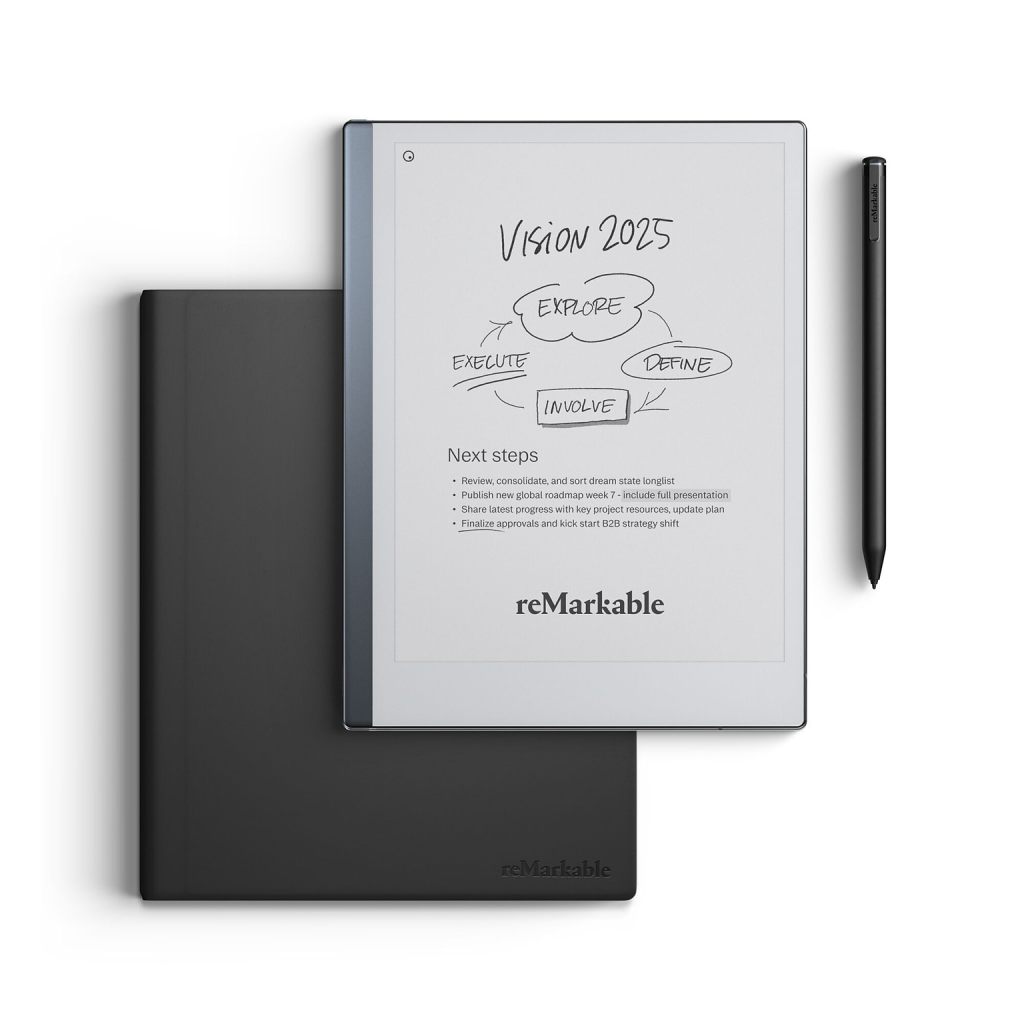
The reMarkable 2 makes an audacious promise for a computer: it will not try to entertain you. There are no games to install, no endless message stream to consult, no tabs multiplying in the background while you are supposed to be working. It presents a blank page and asks what you intend to do with it. In an industry that generally regards uninterrupted attention as a problem waiting to be monetized, that feels almost subversive. The company has built a beautiful machine around an elementary human activity, putting thoughts down in handwriting.
The attraction begins with its shape. The reMarkable 2 is just 4.7 millimeters thick, a measurement that sounds like an engineering boast until you think about what it means for a writing tablet. It does not demand to be held like a laptop, with a keyboard and a carefully chosen viewing angle. It can lie on a table like a sheet of paper. At around 404 grams, it is also lighter than many conventional tablets. The proportions are sufficiently notebook-like that the object seems to invite writing rather than browsing.
What it does not have is just as important. The monochrome 10.3-inch Canvas display has no front light, and the device has no traditional app store. A conventional product comparison might mark those absences down as embarrassing. They can also be understood as an unusually coherent design philosophy. The point is not to produce a compromised iPad. It is to give handwriting a dedicated place, with the ability to save, move and share pages when necessary. I have always liked products that know what they are for.
The surface is the central event. Digital pens once had an awkward relationship with glass; every stroke seemed to announce that you were dragging plastic over a screen. A textured e-paper display brings the gesture closer to writing on a notebook. You can make ordinary notes, rough diagrams, and the kind of half-legible reminders that make perfect sense to the person who created them. Unlike a physical notebook, these pages need not remain where you first put them. You can reorganize them without cutting up a beloved little book.
The pleasure of leaving things out
Digital minimalism often sounds suspiciously like a sermon delivered by someone selling another expensive gadget. The reMarkable 2 is not immune to that contradiction. You could buy many fine paper notebooks for the cost of a dedicated electronic one. Its appeal lies in what happens after the first page: the ability to keep a growing collection of notes together, annotate documents and move material into other parts of a working life. For a writer, that is more interesting than pretending a tablet will improve your character.
The tablet supports handwritten notes, templates, PDF annotation and handwriting conversion. Its companion software extends the notebook beyond the device itself, with integrations that can bring in documents from other services. Those capabilities are useful because they operate at the edges of the experience. Most of the time, the tablet remains a quiet surface. When you are done, the words need not stay trapped inside it. That balance between isolation and connection is the product’s strongest idea.
One of the strangest things about modern work is how often a perfectly good tool becomes a reason not to work. Open a laptop to write a sentence and it may remind you of an email that needs answering, an invoice to send and a news story that has already been replaced by six newer ones. A single-purpose notebook cannot eliminate procrastination, but it does remove several of its most convenient doorways. This is not magic; it is a form of environmental design that happens to use electronics.
Paper is still a formidable competitor. It never requires charging, never depends on a software account and remains readable decades after a manufacturer has ceased to exist. A reMarkable must justify itself by doing things paper cannot do easily. The ability to preserve multiple notebooks in one slim object, revise without leaving a trail of torn pages and move handwritten material into a digital archive is a substantial answer. It is not necessarily the right answer for everyone, but it makes sense to anyone whose writing travels between places and projects.
A lovely machine with a narrow mission
The 8GB of internal storage is modest beside a phone, but comparing those numbers tells us almost nothing about the device. Handwritten notebooks and annotated documents do not generally require the sprawling storage budget of a video library. The more consequential limitation is the absence of a light. A reading lamp or overhead light is part of using the reMarkable 2 in a dim room. Later models address that inconvenience, but it does not turn the older machine into a bad notebook. It simply makes the conditions of use more deliberate.
ReMarkable has discontinued the 2 in favor of newer products, although it says software updates and accessories will continue. That fact changes the buying question. An existing owner has little reason to regard the tablet as suddenly obsolete; a prospective buyer should weigh the age of the hardware against the available alternatives. A mature device that performs its central task elegantly can remain useful for years, especially when that task is as old as written language.
The question of value is almost philosophical. Do you want a tablet that can do everything in a distracted fashion, or a notebook that can do a few things exceptionally well? The reMarkable 2 is easy to misunderstand if judged by the number of applications it refuses to run. It is much easier to appreciate when treated as a small, quiet studio for words and marks. There are faster and more colorful electronic devices; there are also cheaper paper notebooks. Few gadgets occupy the territory between those poles with quite this sense of purpose.
One virtue of a long-lived writing device is that it can eventually become boring in the best sense of the word. The first week with a new gadget is usually devoted to admiring it, adjusting settings and discovering hidden capabilities. Later, if the product is well designed, the ritual fades. You pick it up to write, put it down when you are finished and scarcely think about its operating system. A reMarkable 2 can achieve that kind of familiarity precisely because its vocabulary is small. The tablet has no interest in announcing a new entertainment feature whenever you open it.
That relationship with the machine is almost the opposite of the smartphone experience. The phone is valuable because it brings the world with it; the notebook is valuable because it leaves the world outside. I do not want every object I own to be austere. I appreciate a beautiful screen, a good game and the infinite convenience of a browser. But it is useful to have at least one electronic possession that treats a blank surface as sufficient. The reMarkable 2 still makes a compelling case for that idea.
Five stars, then, not because the reMarkable 2 has everything, but because its omissions are deliberate and its identity is unusually clear. It makes room for handwriting in a life full of screens. That is a modest ambition and, in practice, a rather luxurious one. A good notebook should not be memorable because it kept interrupting the writer. It should be memorable because of what the writer managed to put on its pages.
Product details: reMarkable technical documentation.

