★★★★★ | Five stars
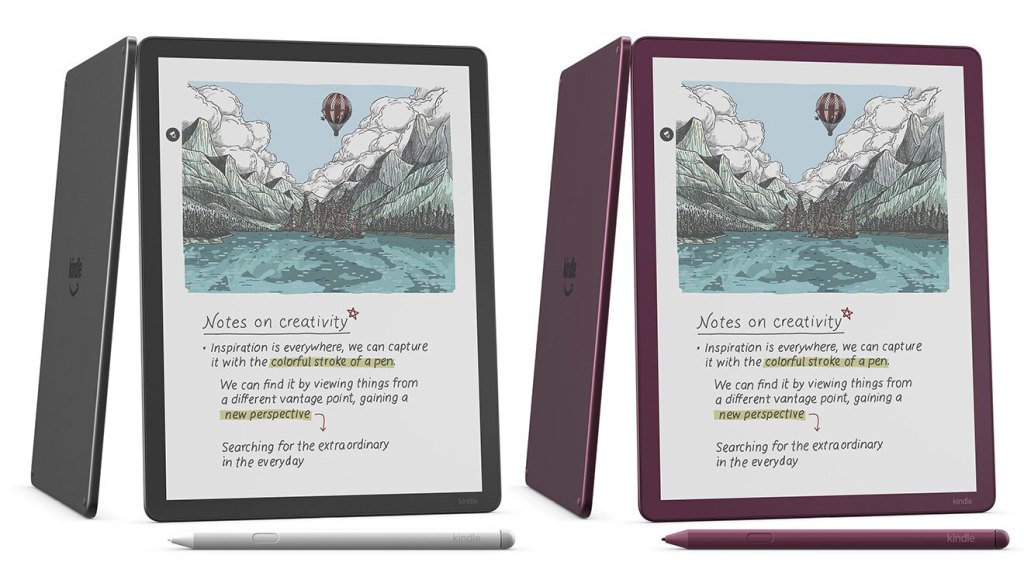
The first thing to understand about the Kindle Scribe Colorsoft is that color arrives here as a working material, not a spectacle. This is not an iPad trying to dazzle you with a movie trailer. It is an electronic notebook that can distinguish a red annotation from a green one, give an illustration a little life and make the act of marking a page more expressive. That sounds like a modest ambition for an expensive tablet. It is also the source of the device’s particular charm.
I bought the 32GB Kindle Scribe Colorsoft from Amazon in December 2025 for $629.99 before tax, complete with the Premium Pen. It arrived on December 17, and I returned it in early January. Those dates define a short period of ownership, not the prelude to a yearlong endurance review. They also establish the exact machine: the original Colorsoft Scribe, a separate product from the monochrome eleven-inch Kindle Scribe and the ten-inch model Amazon introduced in 2022.
Amazon’s move into color e-paper seemed inevitable after the first dedicated color Kindle. The surprise is how sensible it feels on a writing tablet. Ordinary monochrome notes are perfectly legible; a few different colors can make them easier to navigate. A passage can be highlighted without becoming lost in a sea of identical gray markings. A rough diagram can acquire some order. Color gives the page a small additional vocabulary.
The larger eleven-inch surface is another part of the appeal. A typical phone screen encourages quick consumption. A generous e-paper page invites a longer conversation with whatever is being read or written. The Scribe Colorsoft is therefore less a gadget for constant checking than one for settling down. Its proportions are close to a paper notebook, and the Premium Pen makes it possible to respond to the page without resorting to a keyboard.
Color belongs in the margins
The richest use of a colored pen is not necessarily drawing a picture. It might be the little red circle that tells you a passage is important, the blue line that separates two ideas or the green mark that means an objection remains unanswered. Anyone who has carried a few colored pens in a bag will understand. The Colorsoft tries to preserve that language in a device that can also store, organize and transmit the results.
Electronic paper has distinct limits. The colors are softer than those of an OLED screen, and screen refresh behavior is not the same as on a conventional tablet. That is partly why this category exists. A surface intended for text and annotation need not behave like a miniature cinema. Its value lies in being readable and calm enough for concentration. A tablet can be technologically sophisticated without throwing all its capabilities in your face.
The Kindle library gives the Colorsoft an advantage that competitors cannot simply reproduce with better pens. Amazon has already spent decades making electronic books familiar. A Scribe lets the same person continue reading within that ecosystem and add notebooks or annotations when the text inspires a thought. There are frustrations associated with any closed digital bookstore, but familiar books, synchronization and account management can make a device feel like part of an established habit rather than another system to maintain.
The Premium Pen is crucial to that experience. Writing on a touchscreen with a finger feels temporary and a little careless. A stylus invites handwriting, and the eraser and shortcut control make the instrument more like a regular desk tool. Some of the pleasure is physical: the pen remains in the hand while the eye follows the words. The machine succeeds whenever the writer thinks more about the sentence than about the equipment making it possible.
An e-paper notebook also has an interesting relationship with speed. It may be more deliberate than an ordinary tablet, but that does not make the work slower in a meaningful sense. The fastest possible interface is not always the one that helps a person finish a thought. Sometimes a screen with fewer distractions allows attention to remain on what matters. That is why color can be such a clever addition when used sparingly. It enriches the page without changing its fundamental job.
A beautiful niche, made more useful
The Colorsoft costs enough that comparisons are unavoidable. An ordinary Kindle is cheaper and easier to hold on the train. A reMarkable Paper Pro offers a large color writing surface with a different software philosophy. An iPad can do vastly more, at the price of carrying an entire app ecosystem into every quiet moment. The Scribe Colorsoft is for the person who likes the Kindle library and wants the act of note-taking to live beside reading rather than inside a general-purpose computer.
It also belongs to a new family of hardware rather than being merely a color update to the original Scribe. Amazon redesigned the chassis, enlarged the display and built out its handwriting software. Specific features, including AI-based notebook functions, depend on software versions and service availability. The central proposition is more enduring than any particular update: write beside the book, preserve the note and have a way to retrieve it later.
I did not keep the device after the initial purchase period. It would be foolish to write as though I had tested its durability for months or relied on it as my sole notebook through an entire year. What I can assess is the concept, the model I purchased and the appeal of a color writing display within the familiar Kindle world. A return is a fact of ownership, not proof by itself that every aspect of a product was unsatisfactory.
Five stars for the Scribe Colorsoft’s very appealing combination of a Kindle library, generous handwritten page and restrained color display. Its limitations are not mysterious: it is expensive and deliberately less versatile than a conventional tablet. But for the reader who still wants to mark a page, it offers something that a phone and laptop do not quite provide. It gives the book back its margins, this time with a little color.
Another subtle advantage of colored electronic paper is that it can preserve the visual memory of a notebook. People often remember where a sentence sat on the page, or which color was used to mark a particularly useful passage. Those associations are not a rigorous filing system, but they are part of how we actually work with written material. A color annotation can become a small landmark that makes a page familiar when it is reopened. Digital notebooks are at their best when they retain such ordinary pleasures while quietly offering better storage and organization.
The Scribe Colorsoft’s real competition may therefore be the familiar paper notebook rather than a tablet with a faster processor. Paper is wonderful because it never interrupts, never insists on a new version and never asks the writer to learn a menu. The Colorsoft needs to preserve enough of that ease to justify its electronics. Its ability to keep handwritten material alongside a substantial library of books is the interesting addition. The technology becomes worthwhile when it helps the words travel farther without making them feel less personal.
Color is also useful in the reading experience itself. An illustrated nonfiction book, a diagram or a highlighted passage can retain distinctions that disappear on a grayscale screen. There is no claim that the muted e-paper palette replaces a beautifully printed art book. It is enough that the machine offers a little more visual information while retaining the low-key atmosphere that makes a Kindle pleasant. That is a thoughtful compromise, and one that makes the category increasingly interesting.
Product background: Amazon’s 2025 Scribe announcement.

