★★★★★ | Five stars
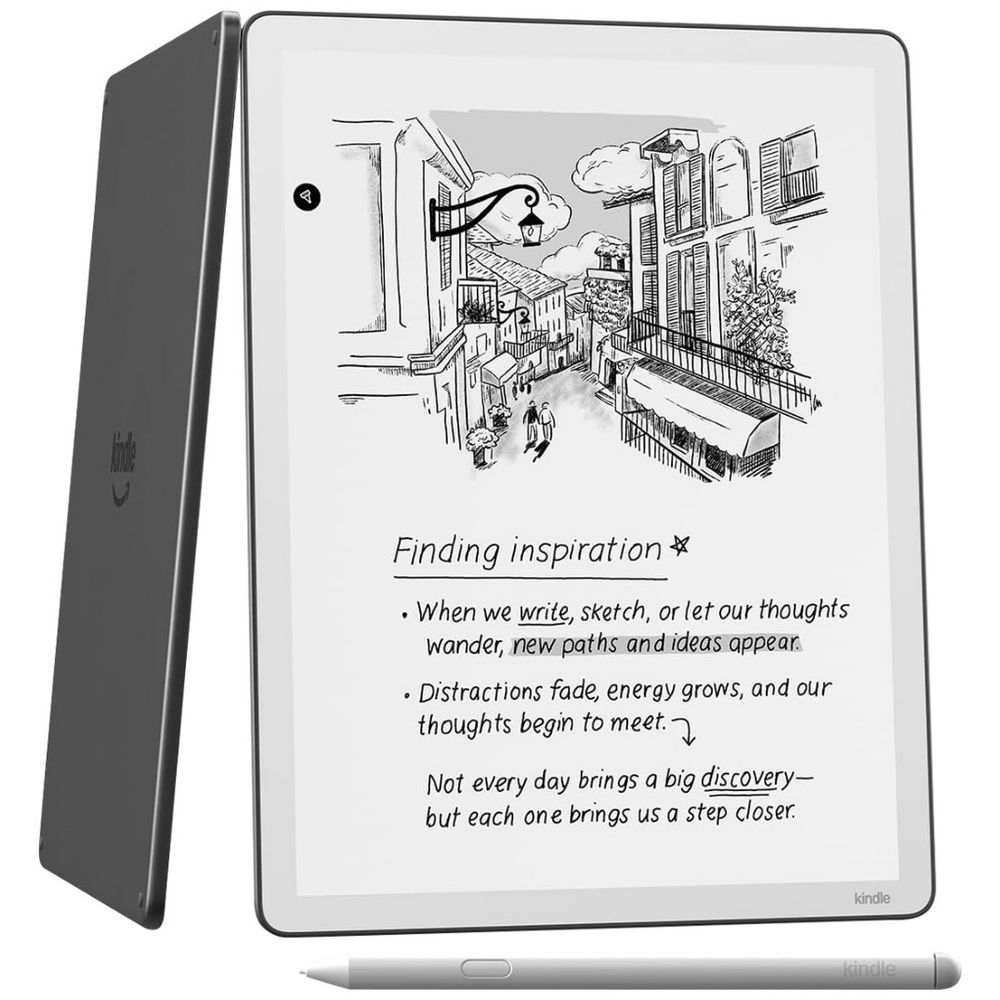
The first Kindle Scribe was a splendid idea in a slightly tentative body. Amazon had taken the world’s best-known e-reader and given it a pen, which seemed obvious only after the company finally did it. The 2025 monochrome Kindle Scribe is a more confident answer. Its eleven-inch display is generous enough for a document, its design has been thinned down, and the whole object feels conceived as a place to work rather than an enormous reader that happens to permit scribbling.
I bought the 32GB graphite version from Best Buy in December 2025. It cost $499.99 before tax and arrived just before Christmas. This was a different machine from the 16GB original Scribe I bought in 2022, and comparing the two is instructive. The new hardware enlarges the writing surface while making the device unusually slim. It does not seek to become a tablet computer in the usual sense. Its ambition is to make reading and writing on the same screen feel like a perfectly natural arrangement.
The screen is the primary reason to look at this model. Amazon expanded the panel to eleven inches, giving a page the proportions of something you might reasonably write on at a desk. The resolution is intended to keep type crisp, while an adjustable front light allows reading after sunset. The monochrome E Ink technology has a quiet appeal. It does not make a photograph look like a television picture, but it can make a page of text feel self-contained and rather civilized.
The physical design is an appealing piece of restraint. There are expensive tablets that advertise themselves through constantly changing colors and a continuous procession of software effects. The Scribe offers a gray surface and a pen. It reminds me that the important quality of a notebook is not the complexity of the machinery beneath it but the ease with which someone can begin a thought and follow it to the end.
A big page changes the conversation
The original Kindle Scribe gave Kindle owners the novelty of adding handwriting to an established reading habit. Its successor treats the notebook as more central. The larger canvas is useful for annotated documents, pages of research and the sort of ungainly handwritten outline that can be much easier to draw than to type. When the page is roomy, there is space for the arrow you only later realize you need. That is not a glamorous feature, but it is exactly what writers ask of paper.
Amazon has also been building software intended to make handwritten material less isolated. Notebooks can be searched and organized, documents imported and annotations handled more flexibly than in the first release. Some functions depend on updates, services and accounts, which is worth checking before purchase. But there is an unmistakable pleasure in the idea that handwritten notes can remain spontaneous when created and become more orderly only when someone needs to find them again.
The Kindle ecosystem gives the device a distinct identity beside the reMarkable and Supernote families. Those tablets are notebooks first. The Scribe is also a doorway to the books a reader already owns. That matters. There is less incentive to reinvent an entire reading routine merely to gain the ability to write. A person can open a familiar Kindle book, make an observation and move to a separate notebook without switching to an entirely different class of gadget.
Handwriting has another advantage that is strangely difficult to explain to someone who regards a keyboard as the ultimate writing instrument. A pen tolerates incompleteness. You can begin with half a thought, cross it out, draw a circle around the part you intend to rescue and go wandering again. A keyboard produces something that looks finished long before the ideas are ready. Digital ink is well suited to the less orderly stages of thinking.
The 2025 Scribe does not need the whole Apple App Store to justify itself. It would be a worse object if Amazon treated every blank page as an opportunity to display another notification. A phone is already available for messages, maps and social distractions. What makes an e-paper tablet attractive is that its surface appears to be reserved for the reader or writer. That is a rare sort of exclusivity in consumer technology.
A useful kind of extravagance
At nearly five hundred dollars before tax, the monochrome Scribe is not a bargain notebook. Paper remains cheap, infinitely intuitive and entirely free of charging instructions. A budget Kindle is also more comfortable for many people who read novels for hours with one hand. The case for the Scribe rests on more specialized work: large-format reading, annotation and the wish to keep a considerable amount of handwriting within reach.
The pen is integral to the experience. Amazon includes its Premium Pen, an instrument with a shortcut button and eraser that makes the tablet’s writing abilities accessible without demanding an elaborate set of on-screen controls. It is a small design decision with outsized importance. A digital notebook succeeds when the stylus seems as ordinary as the pencil lying beside a paper pad.
My purchase history also establishes a limit on what I can claim about ownership. After delivery in December 2025, I initiated a return through Best Buy later that month. This is therefore an account of the design and appeal of a model I briefly owned, not an account of years of durability or battery degradation. Short encounters can reveal the logic of a product. They cannot substitute for a long-term reliability study.
The Scribe still strikes me as a wonderful expression of what an electronic notebook can be. It gives Kindle reading a generous writing surface, treats handwriting seriously and refuses to become another brightly animated distraction machine. Five stars for the idea executed with evident conviction. Anyone who wants a small Kindle for novels should buy a small Kindle. Anyone who wants to read, annotate and think across a large electronic page has a far more interesting choice.
The distinction between a large reader and a small notebook also matters ergonomically. A book invites you to sit back; a notebook asks you to lean forward, or at least bring the surface close enough for a pen. The Scribe is an attempt to reconcile these two postures in one machine. It is not always possible to satisfy both perfectly. Yet the larger 2025 format makes annotation and long documents feel more like primary activities than occasional extras. A buyer who spends an afternoon with research papers may value that more than someone who simply reads novels on the subway.
The Kindle’s simplicity should not be mistaken for the absence of thoughtful software. An electronic notebook is useful only if its contents remain accessible. Folders, text recognition, export options and synchronization are the unglamorous features that turn a nice writing surface into a serious tool. They may not appear in a dramatic product photograph, but they are the features that determine whether a hurried note from last month can ever be found again. Amazon’s continuing development of the Scribe experience is encouraging for exactly that reason.
Most of all, the 2025 Scribe makes a pleasing argument that a product can become more useful without becoming more frantic. The larger screen invites a longer period of attention, the pen makes rough thinking comfortable and the Kindle library offers an immediate reason to open the device. The best gadgets do not necessarily invent a new activity. They make an old, worthwhile one easier to practice.
Product background: Amazon’s 2025 Scribe announcement.

