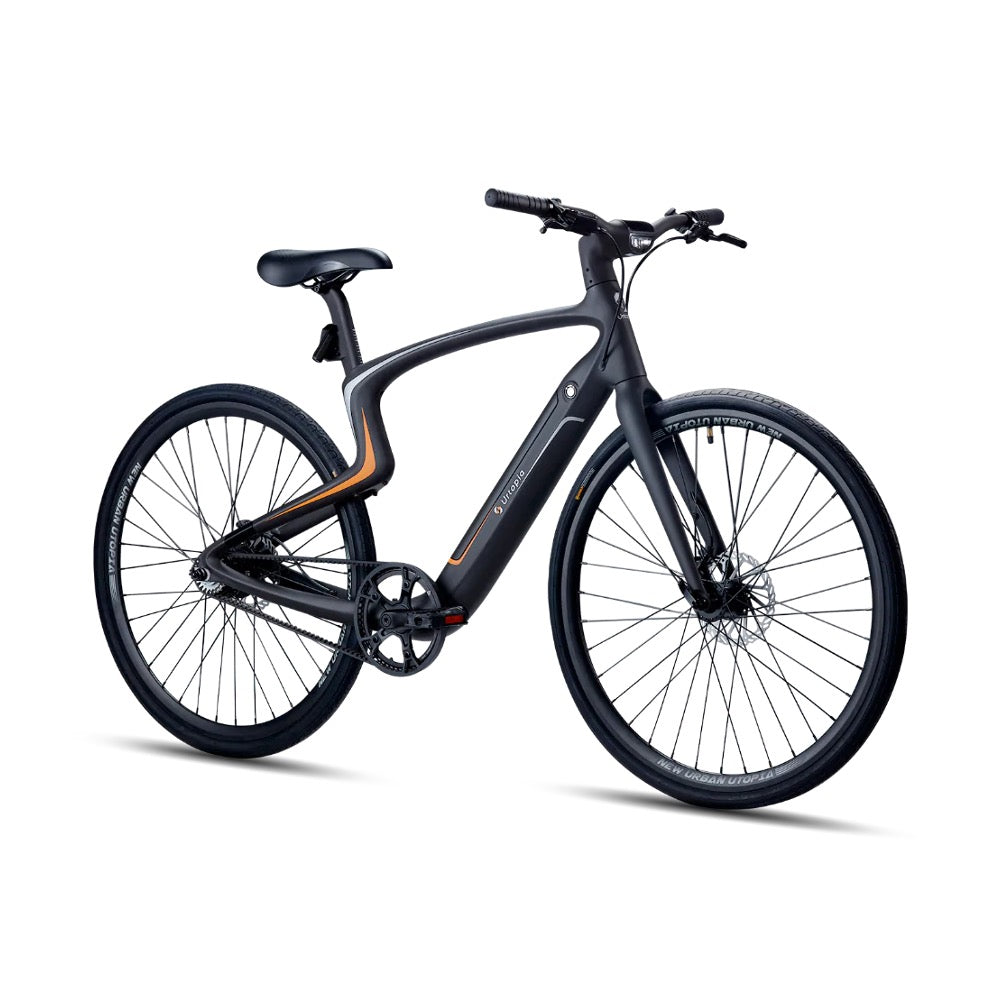
A bicycle with voice commands sounds like a joke until it understands you in New York traffic. The original Urtopia Carbon One did just that when I rode it in 2022. It also had a fingerprint reader, rear radar and turn signals projected onto the pavement. Some of those tricks were useful, others were theatrical. But beneath all the gadgetry was a strikingly light carbon-fiber e-bike that I loved riding.
This review draws on that 2022 ride, not a new test of an older model. E-bike hardware, prices, apps and subscriptions have changed since then. The original machine deserves to be judged as the smart e-bike Urtopia actually put on the road, with all the advantages and compromises of an ambitious first-generation product.
Carbon fiber, not bulk
The Carbon One’s clean, flowing shape was its strongest opening argument. Electric bicycles often carry their weight visibly in a swollen down tube, a chunky motor housing or a collection of accessories. Urtopia concealed much of the complexity in a carbon-fiber frame that looked light on its wheels. The original configuration was advertised at roughly 33 pounds, substantially lighter than many of the heavy commuter e-bikes I have handled. The streamlined design made it feel like the product of a company asking what an electric bicycle could look like, rather than simply where a battery could be attached.
Carbon fiber was both an attraction and a potential complication. It helped keep the bicycle light, but a proprietary frame and an electronics-heavy cockpit would make me ask careful questions about parts availability, crash repairs and the cost of ownership. Anyone buying a used Carbon One today should pay more attention to battery condition and continuing software support than to its original publicity photographs.
Yes, you can talk to it
Urtopia called the electronics assembly the Smartbar. Pairing it with my iPhone was straightforward during my test, and the app recorded rides and estimated how much carbon dioxide I had avoided by cycling rather than driving. These were nice additions, although the part that most amused me was the ability to talk to the bicycle. I could use voice commands to adjust assistance and operate the lights. Despite the traffic and wind on New York streets, the system understood me remarkably well.
Speaking to the bike attracted some odd looks. I understood them. A handlebar button can switch on a headlight more discreetly than announcing a command to the street. Still, the voice system was more competent than I’d expected, and hands-free control made at least some sense when both hands were occupied with steering. Whether I’d keep using it after the novelty passed was less certain.
There was also a fingerprint reader integrated into a touch control on the handlebar. It offered an unusually personal way to unlock the bike and fitted the company’s ambition to make cycling resemble using a smartphone. The companion app paired over Bluetooth, while built-in 4G was intended to enable location tracking and updates. I did not stage a theft or prove that the system could recover a stolen bike. As a security feature, connectivity is only as useful as the services and subscriptions that continue to support it.
Turn signals on the pavement
The Carbon One’s projected turn signals were charming. Light from the bike drew directional indicators onto the pavement, a theatrical approach to the routine problem of communicating with nearby traffic. In daylight the projection was too faint to trust as my sole signal. At night it was more effective. I still used hand signals and paid attention to the people around me. The projections made the bike conspicuous without making the rider invulnerable.
Rear-facing millimeter-wave radar was another ambitious addition. The system was designed to warn of approaching vehicles, using audible alerts to convey information. I could hear it over traffic, though the beeps were conspicuous enough to draw attention. I treated it as a supplement to ordinary awareness, not as a way to outsource looking over my shoulder. Cycling in New York is simply too unpredictable for that.
The ride underneath the gadgets
I enjoyed my time on the Carbon One. That is a less complicated verdict than the list of sensors suggests, but it is the one that matters. The low apparent weight and clean design made the bike approachable, while the powered assistance took some of the work out of getting around. The unusual electronics were fun to explore without being the whole reason to ride.
I wouldn’t invent a battery rundown, measured braking distance or sustained hill-climbing comparison from an afternoon spent examining connected features. My contemporary reporting concentrated on the technology and the pleasure of riding it, not on a laboratory-style road-test protocol. That matters particularly for an older bicycle: manufacturer range estimates should not be mistaken for what a secondhand battery can deliver now.
The compromises were clearest where cleverness interfered with simplicity. Voice commands and a fingerprint scanner were memorable but added more things to configure. The projected turn signals depended on lighting conditions. Radar warnings offered useful information but could be noisy. A more ordinary commuter might have been easier to own and service, particularly if a dealer could repair it without proprietary tools or an active app.
Verdict
The original Urtopia Carbon One was a genuinely enjoyable bicycle with an extravagant appetite for technology. Its most successful quality was not any particular sensor. It was the way the hardware made a striking, comparatively light e-bike feel like something new. I loved riding it, and the voice controls and projected signals gave me more to talk about than almost any ordinary bicycle could.
Would I buy one today? Only after checking its current battery, parts and connectivity support. The 2022 version I rode was delightful as a contemporary experiment, but it is no longer a newly launched product. For someone considering a used example, condition and service matter far more than a list of features preserved from the launch brochure.
Testing disclosure: Based on my firsthand 2022 ride of the original Urtopia Carbon One in New York City. No fresh 2026 road test was conducted. Later model revisions may differ. Original reporting appeared in Digital Trends. Archival product image: Urtopia via Zero Center.

