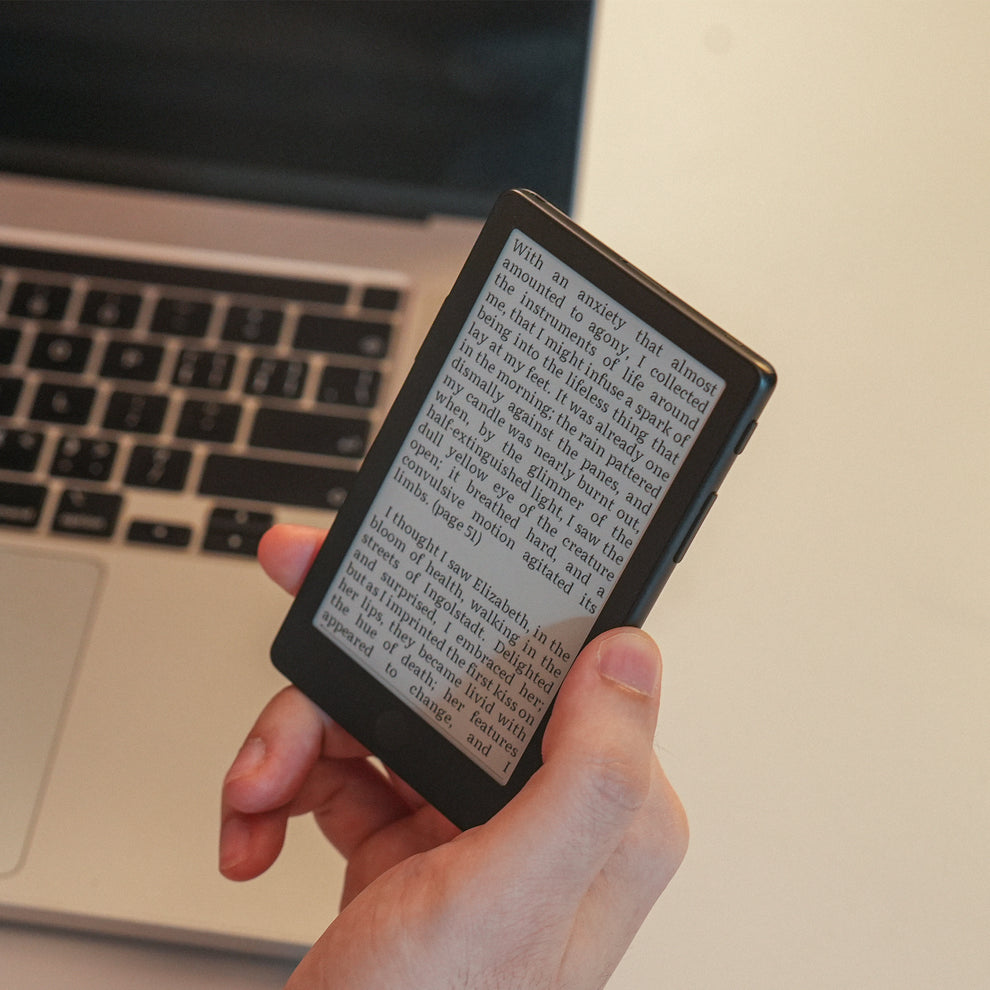
I used to think of reading as something I would do later. On the train, perhaps, or at home when work was finished. Then I bought an Xteink X4 Pro, an e-reader barely bigger than a credit card. Now a book can go wherever I go. It fits in a pocket, weighs almost nothing and does one thing: displays the words I want to read.
My phone has books on it, too. The trouble is everything else. I pick it up to read and notice an email, then a headline, then some other little emergency that didn’t exist thirty seconds earlier. The Xteink has none of that. I open a book and get a page of text. It’s almost absurd how refreshing this feels.
Most e-readers have followed a predictable path: bigger screens, better lighting, color displays and more elaborate software. A handful of pocket-sized models are heading the other way. Their appeal is that they are so easy to carry that reading becomes possible almost anywhere.
The appeal of a four-inch book
The Xteink X4 Pro has a 4.3-inch E Ink screen and weighs 72 grams, according to the company. At 111 by 69 millimeters and just under 6 millimeters thick, it occupies a different physical category from the six- and seven-inch models that dominate the e-reader market. Xteink sells it for around $99, depending on configuration and availability. There is no sense in calling this a full-size Kindle substitute without qualification. It is an object designed to make a book available in spaces where a Kindle might be left at home.
The screen is tiny. A long paragraph can fill most of it, and you turn pages constantly. On a larger reader, those would be obvious disadvantages. Here I find them easy to forgive. I can read a couple of pages without taking out a phone, opening an app or finding room for a larger device. I don’t need to arrange my day around a book.
The X4 Pro’s screen resolution is 219 pixels per inch, below the 300 ppi common in pricier Kindle and Kobo models, but sufficiently dense for legible prose at an appropriate type size. A front light, adjustable between warmer and cooler tones, distinguishes the Pro from Xteink’s original X4. The newer device also has a touchscreen, physical page-turn controls and a dedicated home control. Xteink includes a 16GB microSD card and says the slot accepts cards as large as 256GB. Those numbers verge on the comical for a device intended mainly to display text.
Buying from Xteink has not been entirely painless. I encountered a charging problem with an earlier device and arranged a replacement. That doesn’t establish whether the fault was common, but it’s a reminder that small hardware companies may offer less polished support than Amazon or Kobo. I still like the idea enough to keep reading on one.
What happens when the notifications stop
There’s no shortage of reading material on a smartphone. The difficulty is staying with it. You unlock the screen for a novel, see an incoming message and answer it. Now you’re in email. Then you remember something you meant to look up. The book is still open somewhere, but the moment for reading has passed.
On the Xteink, there are no messages to answer and no feed to check. A book doesn’t compete with anything else on the screen. I don’t have to practice heroic self-restraint. I simply read.
Of course, a paperback also keeps distractions away. But even a small paperback takes space, and I don’t always want to carry a bag. The Xteink gives me much of that same quiet in an object I barely notice carrying.
Two ways to shrink an e-reader
Tiny e-readers are not new. Manufacturers have tried pocket-sized reading gadgets for years, with mixed success. What’s interesting about the current crop is how differently they approach the job. Some are basically smartphones with E Ink screens. Others, like the Xteink, strip out nearly everything but the book.
The Boox Palma 2 demonstrates the first approach. It has a 6.13-inch E Ink display, weighs about 170 grams and runs Android, with Google Play access and a substantial selection of reading apps. It can handle library software and other services that the Xteink does not natively offer. Its phone-like shape is familiar, and its additional processing power makes it considerably more adaptable. The cost of that flexibility is that the owner has once again acquired an interface capable of supporting many things besides a book.
The Xteink’s 4.3-inch display makes a different wager. It is smaller even than the Palma, and the software is deliberately limited. There is no fully fledged commercial bookstore built into the X4 Pro. You import supported ebook files, generally through Xteink’s phone app or from a computer. The device is happy to read an EPUB but cannot magically reach into a Kindle account and retrieve every purchased novel. That distinction makes the hardware wonderful for some readers and a deeply irritating proposition for others.
A recent Pew Research Center analysis offers useful perspective on the larger market. In an October 2025 survey, 31 percent of American adults said they had read an ebook within the previous year, compared with 17 percent in 2011. Print remains more widely read, with 64 percent reporting a print book in the previous year. Those findings do not measure demand for tiny readers, much less prove a booming movement. They do show that electronic reading is a settled part of ordinary life, leaving room for devices that challenge the familiar tablet-sized form.
The catch: Getting books onto it
This is the Xteink’s most irritating limitation. It supports formats including EPUB and TXT, and the companion app can transfer compatible books and some web content. But books protected by the digital locks used by major retailers won’t generally work. There’s no Amazon-style button that buys a title and sends it instantly to the device. You have to find a suitable file and load it yourself.
The situation is different for public-domain literature, DRM-free purchases, personal documents and the growing body of fiction that authors make available for direct download. Standard Ebooks, for example, offers carefully produced editions of public-domain works. Calibre, the longstanding ebook-management application, can help organize suitable files on a computer. The hardware’s small screen is not well suited to fixed-layout PDFs, technical diagrams or intricate footnotes, but a plain novel or essay remains entirely at home.
Moving files around can feel like a return to the days of syncing an MP3 player. If you want to buy the latest bestseller and start reading in seconds, a Kindle or Kobo will usually be easier. The Xteink requires more patience before you get to the first page. I wish that part were simpler.
Xteink’s official material specifies a 1,100mAh battery but does not offer a simple, universal endurance figure worth repeating as a personal result. Reading time depends on front-light use, wireless transfers, firmware and other variables. Nor would I claim to have subjected my device to a laboratory battery rundown or measured its display against calibrated instruments. The case for the device begins with a personal change in where reading fits into the day, not with a chart of numbers it is easy to overstate.
The minutes that used to disappear
Waiting for an appointment or standing in line rarely seems like an occasion to start a book. Yet those minutes add up. A tiny reader makes it easy to read two pages, then put the book away. I don’t have to scroll through a phone looking for something to fill the time. I have already decided what to do with it.
I still prefer a bigger screen for a long stretch of reading at home. But a six-inch Kindle is something I must choose to carry. The Xteink is easier to bring along by default. That difference sounds trivial until it means the book is there when an unexpected chance to read appears.
A small device that earns its place
Another gadget is not automatically an improvement. Making electronics consumes resources, and a phone already has the ability to display books. A pocket reader makes sense only if it changes how much you actually read. Otherwise, it’s an expensive way to carry a duplicate screen.
The Xteink won’t suit everybody. Large type, pictures, detailed footnotes and effortless library borrowing all work better on larger or more capable devices. Some people are perfectly happy reading on a phone with notifications switched off. Others prefer paper. The question is what gets you to open a book more often.
For me, this ridiculous little reader has made a real difference. I don’t need to find half an hour, settle into a chair or wrestle with the phone’s endless invitations. I can take out a book and read a page. Then another. The moments I used to waste now belong to whatever I’m reading.
I like that the Xteink doesn’t want to replace my phone. It doesn’t want much of anything from me. It just makes books easier to reach. That’s enough.
Reporting notes: I purchased Xteink hardware myself. Product dimensions and features are attributed to Xteink; competitor specifications to Boox; U.S. reading statistics to Pew Research Center. This essay describes my experience of the small-reader format, not a controlled battery or display test. Product photograph: Xteink.

