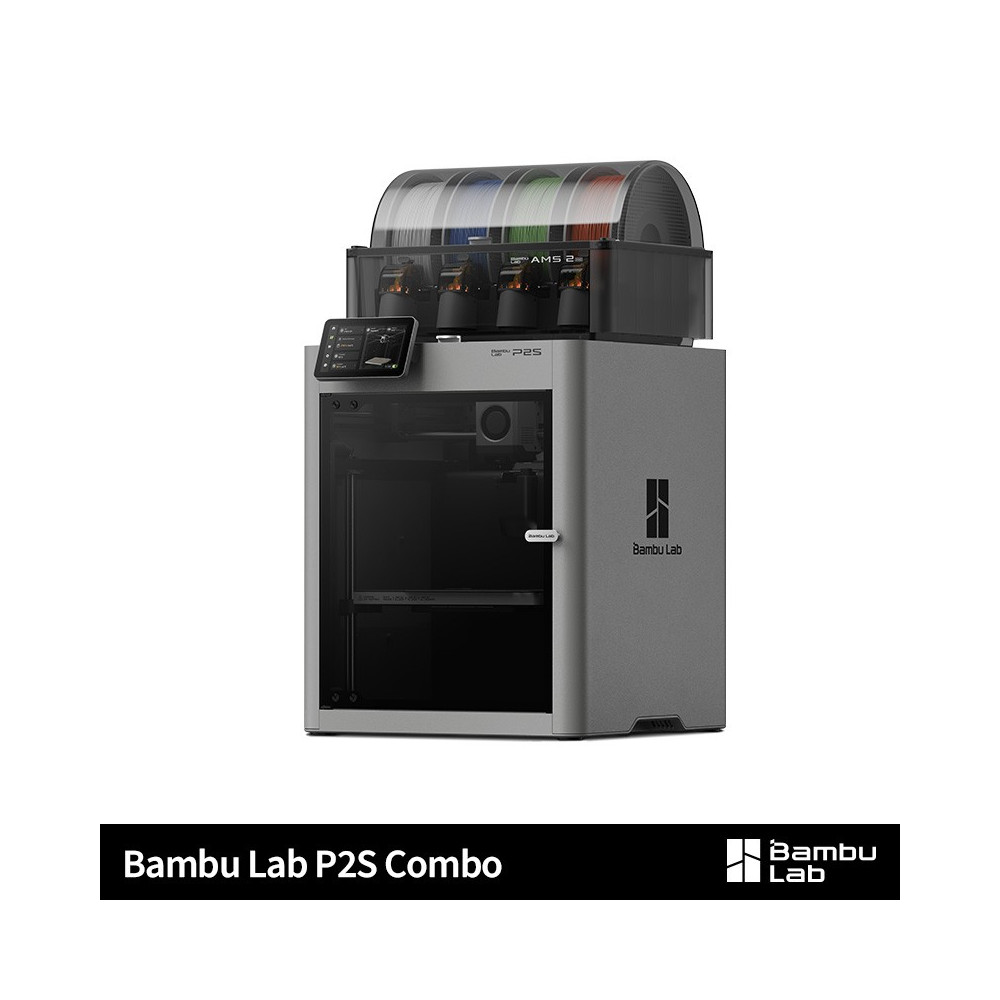
Bambu Lab P2S Combo. Product image: Bambu Lab / Crea3D.
A 3D printer can make you feel like an engineer or a maintenance worker, depending on the afternoon. A badly behaved machine demands an intimate knowledge of hot ends, bed adhesion and the subtleties of plastic filament before it will produce a useful bracket. Bambu Lab’s P2S Combo is intended to narrow the distance between wanting an object and obtaining one. It pairs an enclosed printer with the AMS 2 Pro automated filament system, bringing material handling and calibration into a more integrated experience. The ambition is not merely to print faster. It is to make printing less of an occasion.
The P2S arrived in 2025 as the successor to the widely used P1S, retaining a build volume of 256 millimeters on each side. It is not a miniature machine, nor does it feel like a bare collection of mechanisms assembled on a hobbyist bench. Glass, metal and plastic form a substantial box that belongs on a dedicated table. Its five-inch touchscreen and internal camera make it feel closer to a contemporary appliance, although the comparison breaks down as soon as the user begins selecting among different plastics, temperatures and support structures.
The small changes are the point
Bambu has upgraded the extrusion system, the cooling arrangements and the controls rather than abandoning the fundamental format. The redesigned extruder is intended to manage material delivery with more authority, and an adaptive airflow system changes how the enclosed chamber handles heat. PLA generally benefits from cooling, while some engineering materials require a warmer, more stable chamber. In a simple open-frame printer, the user has to think about those conflicting demands almost constantly. Bambu is attempting to make the machine take a larger share of the responsibility.
The P2S also pays attention to the first minutes of a job. Automatic leveling and calibration reduce the number of manual interventions before the first layer, which is often where a print announces that something has gone wrong. The interface guides the operator through the sequence instead of exposing a bewildering set of settings from the start. The setup documented in my evaluation was notably straightforward, without the fiddling that used to be considered a rite of passage for desktop printing.
That friendliness should not be mistaken for an exemption from materials science. Different filaments expand, cool, absorb moisture and bond to the build surface in different ways. A machine can make the process easier without repealing those properties. It still matters whether the model is appropriately oriented, the material suits its intended job and the object can withstand its expected loads. The P2S is at its best when it conceals routine maintenance without pretending that every complex print will succeed automatically.
Four spools make printing more interesting
The Combo includes the AMS 2 Pro, an automated material system that houses four filament spools and feeds the printer as a job requires. The appeal is immediate: an object can use different colors or materials without a person standing beside the machine to make every swap. The mechanism can also manage filament drying, addressing moisture that can produce poor surface finish and unreliable extrusion. In a humid environment, that is a practical advantage rather than an obscure accessory feature.
The complication is that automatic material changes have a cost. Each transition requires the system to cut, retract, feed and purge material, consuming time and producing waste. A multi-colored decorative object may be lovely, but its apparent convenience can conceal a lengthy succession of changes. It is sensible to compare the ambition of a project with the number of transitions it demands. The automation reduces hand labor, not the physical material that must move through the hot end.
The AMS unit also adds size and cost to the setup. This is not a product for a crowded corner of a small apartment unless that corner is genuinely reserved for fabrication. The printer itself has a substantial footprint, and the filament system needs room for spools, cables and access. A tidy-looking enclosure can still become a workshop when the owner begins storing filament, replacement parts and the collection of objects that seemed worth printing at the time.
Speed and quality are different questions
Bambu advertises a maximum movement speed of 600 millimeters per second and very high acceleration. Such figures describe the machine’s capabilities under specified conditions, not a promise that every useful object will emerge at that rate. Curved surfaces, small features and materials that need controlled cooling may demand far slower movement. Quality is judged on the finished object: whether details are crisp, corners are controlled, the layers bond and the part remains dimensionally useful.
The evaluation material describes clean, detailed prints and reliable handling of more than one filament type. Those observations are encouraging, but I would not turn them into claims that the printer never jams or that every material can be printed without intervention. Even a highly automated machine remains sensitive to model design, moisture and the selected profile. What makes the P2S compelling is a reduction in the number of routine problems, rather than a supernatural ability to abolish them.
The integrated camera is another genuinely useful feature. It allows the owner to inspect a print without standing in front of the enclosure throughout the job. That does not mean a camera can save a model that has detached from the bed or recover filament already wasted by a bad setting. But it changes how much attention a long task demands. Monitoring becomes possible as a periodic check instead of a form of anxious supervision.
The ecosystem is both the advantage and the price
Bambu Studio and the machine’s preset workflows are a large part of the package. The software is intended to simplify the movement from a digital model to a physical print, with profiles for the printer, available materials and the automated spool system. Owners who have spent years assembling a 3D-printing workflow from disparate tools may find that integration a relief. It is also worth noticing how much of the convenience depends on a particular manufacturer’s components, profiles and replacement parts.
There is no ordinary Ethernet port, an omission that will matter to some people running a more formal workshop or who prefer wired networking. The machine supports wireless connectivity and local file transfer methods, but an integrated ecosystem is never completely neutral. Changes to firmware, software support and parts availability can alter the experience of ownership over time. A printer bought for serious work should be evaluated partly by how repairable and sustainable that system appears.
The P2S Combo belongs to a generation in which desktop 3D printing is trying to become an ordinary production process rather than a hobby defined by troubleshooting. It is appealing for a designer who wants prototypes, an enthusiast making functional objects and a small workshop that values repeatable setup. It is less compelling for somebody who enjoys extensive hardware modification or wants the most open possible platform. Automation and freedom to tinker sometimes pull in opposite directions.
The printer’s achievement is not that it makes the technology disappear entirely. A 3D printer still melts plastic according to a complex set of mechanical and thermal constraints. The achievement is that many of the ordinary chores are managed with enough confidence for the operator to think about the object rather than the machinery. The P2S Combo is expensive and space-hungry compared with an entry-level printer, but it offers an unusually coherent way to turn an idea into a physical thing. That is the sort of progress worth noticing.

