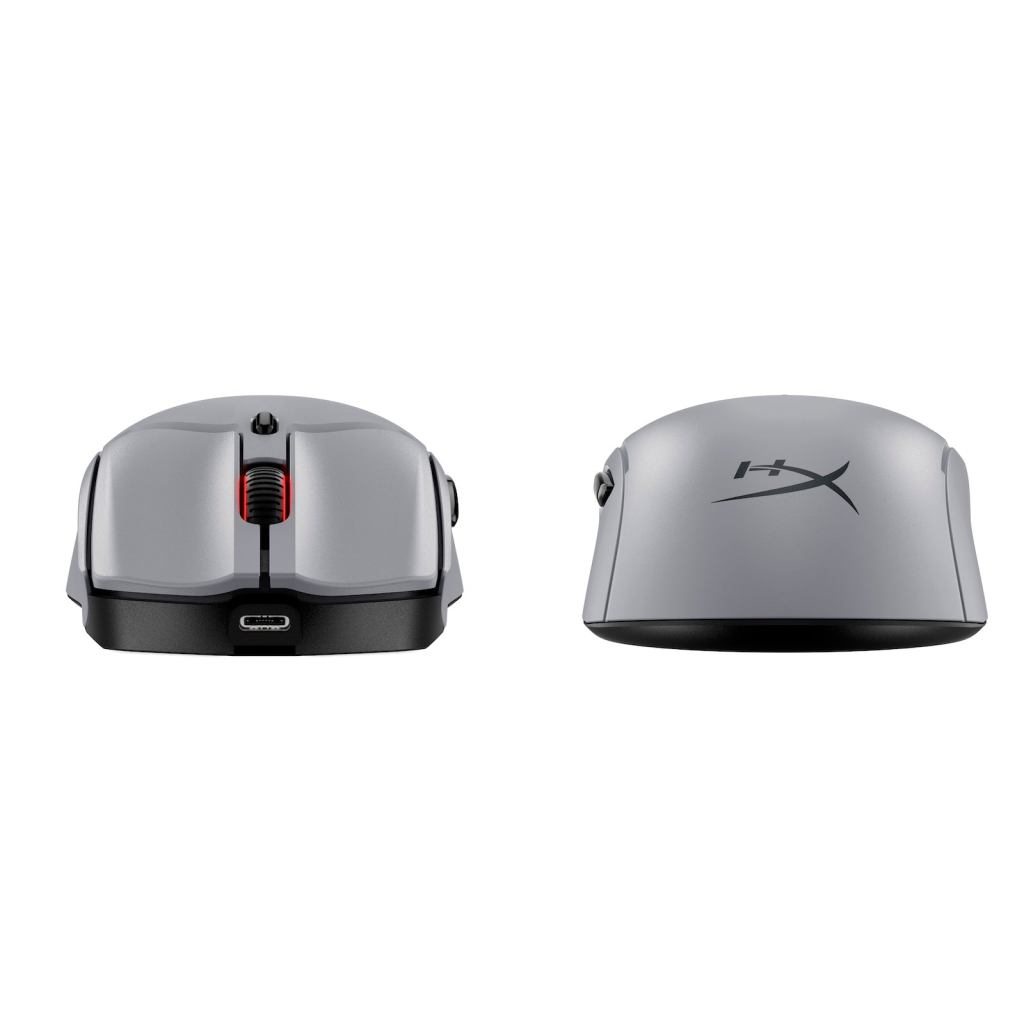
The race to build a lighter gaming mouse has produced some peculiar designs. Shells resembling slices of honeycomb, cables that promise to disappear and prices that would once have purchased an entire keyboard all exist in service of moving a pointer across a screen. HyperX’s Pulsefire Haste 2 Pro 4K takes a more sober approach. Its shell is solid, its shape is uncomplicated and its 61-gram weight is low without becoming the central spectacle. After using it with competitive games and a high-refresh-rate display, I came away thinking that the absence of fuss was its strongest feature.
The $119.99 mouse offers a HyperX 26K optical sensor, a 4,000Hz wireless polling option and optical switches, putting its core performance specification close to more expensive competitors. But performance numbers rarely explain whether an object feels trustworthy under the hand. What impressed me was the consistency of the tracking and the reassuring solidity of a lightweight shell. The trade-offs arrived in battery endurance at the fastest setting and in software that feels less ambitious than the hardware.
A solid shell without the heavy feeling
The Pulsefire Haste 2 Pro 4K weighs about 61 grams despite a closed, ordinary-looking body. The matte finish has enough texture to remain secure during long sessions, and I could not produce the sort of creaking or flexing that can make some especially light peripherals feel disposable. HyperX includes optional grip tape and replacement skates. Those accessories are not glamorous, but they suggest an awareness that a mouse lives under repeated contact and that small wearing surfaces eventually need attention.
The shape is symmetrical and relatively low, with a centered hump that suits claw and fingertip grips better than an elaborate palm-resting hold. In my time with it, rapid movements were easy and the mouse stayed predictable when repositioned. Someone with very large hands who wants a tall arch may prefer another design. That is not a failure of ergonomics; it is a consequence of committing to a particular shape rather than trying to make the mouse comfortable for every possible hand.
There is little lighting to distract from the practical form. A restrained illuminated detail around the wheel is enough to signal that this is gaming equipment without turning the desk into a display case. The build feels more serious than the price might suggest, and the uncomplicated silhouette works just as well beside office equipment. For a product intended to move quickly, it is pleasingly reluctant to draw attention to itself when stationary.
The four-thousand-hertz question
The mouse can send up to four thousand reports each second over its wireless connection. At the familiar 1,000Hz setting, a report can arrive every millisecond; at 4,000Hz that interval is a quarter of a millisecond. The arithmetic is straightforward. Whether a player can perceive the difference is not. Display refresh rate, the game engine, CPU scheduling and the rest of the input chain all intervene between the device and what appears on screen.
My testing included a 240Hz monitor and comparisons between the standard and higher polling settings. Small aiming corrections felt somewhat smoother with the faster option, though the improvement was subtle. I did not conduct a controlled latency experiment and would not attach a numerical performance gain to the subjective difference. In ordinary desktop work and less demanding games, the standard mode already felt highly responsive. Four thousand reports are an option, not an obligation.
The extra reports come with a cost. HyperX rates the mouse for up to 90 hours at 1,000Hz but around 30 hours at 4,000Hz, under the company’s test conditions. That is a large reduction in advertised endurance. Users who spend long stretches away from a charging cable should decide whether a subtle responsiveness benefit is worth more frequent charging. The answer may change from game to game; a setting suitable for an intense competition need not become the default for browsing and writing.
A good sensor is only part of control
The HyperX 26K optical sensor is quoted at 26,000 dpi, with high tracking-speed and acceleration tolerances. Those ceilings are not especially meaningful for most people. A comfortable sensitivity setting and accurate response at ordinary hand speeds matter far more. During deliberately abrupt movements in my testing, the pointer did not exhibit the obvious spin-outs or erratic behavior that would undermine confidence in the device. The result is a gaming mouse that feels fast because it is dependable, not because a number on the packaging is enormous.
The optical switches are similarly reassuring. Their clicks have a defined tactile break, and repeated inputs felt crisp rather than vague. The side buttons are conventional rather than lavish, and the scroll wheel offers recognizable steps that make it easy to select items in games. There is not an elaborate thumb-control system here. The mouse concentrates on the primary actions competitive players use constantly and leaves more specialized productivity duties to other designs.
The software lagging behind the hardware
HyperX NGENUITY gives access to sensitivity, button mappings and other settings. For a mouse at this price, the limited onboard-profile capacity feels restrictive. A player who changes computers or games regularly may want several configurations stored directly on the device, without relying on installed software to recover preferences. The physical mouse is admirably straightforward; its software ecosystem is less polished than those offered by some competitors.
The included grip tape and replacement PTFE skates improve the value proposition in a practical way. They do not make the mouse faster, but they help the owner adapt its feel and maintain its glide. It is easier to defend a $120 peripheral when the manufacturer acknowledges that an input device is a consumable object in certain respects. A flashy accessory that offers no useful spare parts would be less considerate.
The Pulsefire Haste 2 Pro 4K is an excellent option for somebody who values a low-weight, consistent gaming mouse and wants high polling without paying the largest premium. I liked its sturdy construction, crisp buttons and dependable tracking, and I could appreciate the faster mode on a 240Hz display without becoming convinced that everyone needs it. The weaknesses are a narrow software feature set and the battery penalty at maximum polling. HyperX has produced a mouse that makes impressive technology feel uneventful. That is praise.

